
The Double Refuge ☠️ Ars Moriendi
Beyond Whose Bourne
Wheels - Mudroom of the Psyche - Waving Goodbye - The Garden of Paradise
☠️
Wheels
Atheists dismiss the religious experience of other people. They see it as merely the product of brain chemistry, early indoctrination, self-fulfilling prophecy, the placebo effect, the fear of meaninglessness, the fear of death, etc. Yet they’re less eager to explain away their own experience as hormone-driven, indoctrinated, or self-induced.
Experience is the stuff of our being, and as a result it can be more convincing than logic and reason. Moreover, the intellect isn’t some detached or foreign thing: it comes from the brain, which is intimately connected to the body and to our feelings in a billion subtle ways. The brain-body complex brings together the extraordinarily diverse and powerful flows (of sensation, perception, feeling, thought, memory, fantasy, fear, and hope) that constitute our state of being.
Throughout The Double Refuge I’ve argued that experience is often more powerful than reason in determining our belief system. This was obviously the case when I had a series of nightmares in 2025: the dreams shifted my position from being an open agnostic to being a double refugee (see 🍏 Dreamtiger Journals). This shift was prefigured almost a decade earlier in 2016, several months after my father died, and while my sister was taking a course on Colossians at nearby Regent’s College.
The dream I had at this time started to change my point of view, which slowly evolved over the next decade from open agnostic to double refugee. What made me change wasn’t intellectual history or existential philosophy. Rather, it was the personal, emotional effect of my sister, taking a course at Regent’s College, and my father, cremated months before and floating somewhere in my psyche.
Despite my rational tendencies, this dream made me question — again, and in a deeper way — the agnostic arguments I had focused on up to then. The dream made me feel that agnostics and atheists miss something crucial when they distance themselves from religious belief. Perhaps the train is in the station, ready to take us to a better place. Meanwhile, we examine the schedule, and question its authenticity. We wonder if the station itself isn’t on the other side of town. Or perhaps this town has no train station. Perhaps we should be looking for a bus.
While my dream wasn’t shocking or fantastic in any way, it was my dream, and not the dream of someone else. Mine. And because it was mine, it influenced me as much as the arguments of other people, from Sartre to C.S. Lewis. Perhaps the biggest reason it continues to make me skeptical of atheism and hard agnosticism is that it wasn’t an intellectual argument. Rather, it was a simple experience, tinged with sadness and love.
The following is what I wrote immediately after the 2016 dream. An open agnostic, I hadn’t yet imagined teh notion of a double refuge. Yet this dream got me thinking — and feeling — in that direction.
☠️
The dream started in the dining room of our house in Calgary. It ended with my sister waving at me from the top of a bus (or a train, I couldn’t tell) on a road that cut through deep green hills.
It started with my dad in the dining room. Once vigorous, almost military in his 8 AM Saturday morning clarity, in my dream he was no longer able to direct the troops. He could no longer get us to mow the lawn and weed the garden, and do all the other chores that seemed so important to him, but to us just seemed like his way of wrecking Saturday morning.
I left him in the dining room, mumbling something that I can’t remember. I went to the mudroom in search of whatever it was the dream was about.
I should explain that my dad died several months ago, after a long slide into complete dementia. Most probably, this descent from sanity was the reason he sat at the head of the table in the dining room, bereft of all direction.
While I still have no desire to weed the garden or plant begonias (whatever those are), I wish that my dad could still marshal the young troops into the backyard. I can almost hear him whistling seventy-six trombones lead the big parade, his favourite marching tune, as we trudged to our Saturday morning battle with weeds and roots.
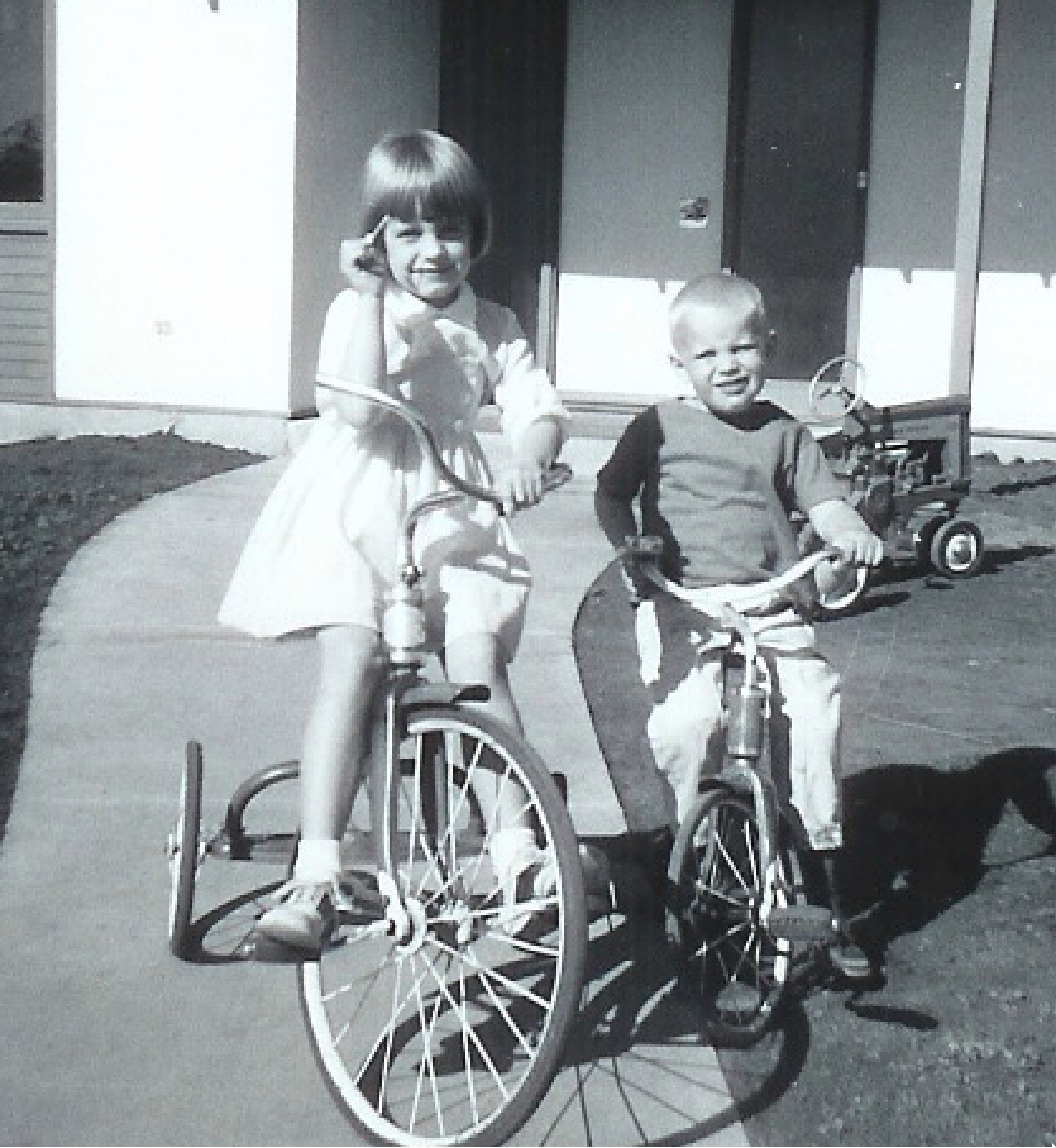
Here are two photos taken in Edmonton, circa 1963. In the second photo, my father seems to be attempting to interest me in trimming a tree. Although I appear to be concentrating on my task, I suspect that I was just trying to figure out how to get back on my tricycle.

The relation with my father may seem to have nothing to do with my theme: the tension between my doubt and my sister’s belief. Yet it has everything to do with the experience of dreams, which is mysteriously connected to the experience of our waking selves. Dreams draw currents from deep inside us. These currents blend with currents that flow from elsewhere, from outside of us. The mix of these currents contours our thoughts and feelings, and plays a part in sculpting our beliefs.
☠️
Mudroom of the Psyche
In my dream I left my father at the dining room table and headed to the mudroom.
The mudroom was the one room in the house that no one thought much about. Yet this almost forgotten space speaks more to me now than the volumes of the adjacent den, with its shag rug and its loud, all-important TV. Perhaps it’s because the TV was omnipotent (transfixing our thoughts every evening) and omnipresent (in all dens at the same time, everywhere saying the same thing to everyone) that it doesn't have much to say about our family in particular.
Mute and almost invisible, the mudroom has more to say.
In my dream I don’t remember what it was that I was searching for in the mudroom. Perhaps something I needed for the upcoming journey to find whatever it was the dream was about. Perhaps I was just going to the bathroom, which our parents always encouraged us to do before getting into the car. This makes a certain amount of sense spatially, since the bathroom was in the mudroom, and the door to the mudroom was next to the door to the garage.
The mudroom was composed of three rooms: a washroom (the only one on the main floor), which faced a closet with baseball gear and jackets hanging from pegs, and a larger main room, with a washer and dryer. Across from the washer and dryer was a white wooden bench, set sturdily into the the back wall of the mudroom. On the left side of the bench was an opening, which is where the milkman used to deliver milk each morning (the same opening was also used by our many cats).
I remember this bench because it was here that we were spanked. Pants down. Slap, slap, slap.
I should note that my parents weren't abusive, unless you think that spanking is abusive. My parents were very caring, yet they had to raise four children who listened to the Beatles and the Rolling Stones. You say you want a revolution. Get off of my cloud.
It was also on this white wooden bench that my sister was forced to swallow pieces of banana. My parents made her do this so that she would be able to swallow her vitamins (my mom was fanatic about vitamins). Whether this really happened in the mudroom, or whether I’m superimposing an event on a different location, I’m not completely sure. In any case, this forced banana-eating was unacceptable to me. But then again I didn’t believe in taking vitamins either. Certainly not in training to take vitamins. And certainly not in being forced to eat bits of bananas in the mudroom.
Or perhaps my dream-mind went to the mudroom because it was the source of potential danger. Next to the dryer was the side door of our house, and this door was often unlocked. One evening a neighbourhood punk came into our house through this door. I still remember the feeling: He was in our house!
The mudroom represents a number of things: the lifting of jackets and baseball gloves from hooks, hurried trips to the bathroom before scrambling into the car, the rumbling of laundry, spankings, bananas, and danger.
I've perhaps lingered too long on the mudroom, especially since I don't know what it means. Perhaps Dr. Freud could tell me. But it’s worth mentioning precisely because I don’t know what it means. It remains connected to the subterranean currents of what makes us who we are — tangled networks of experience, daily chores, expectations, sports, rules, punishment, fear, etc.
In my dream, I went purposely to the mudroom, to find what — or to do what — I don’t know. I then brought this whatever the mudroom meant with me to the garage, or at least in the direction of the garage.
The garage was the location most connected to exploration and adventure. Initially, it contained my tricycle, and then my bicycle. Later, it was where I could find my bright green Suzuki 90, the ultimate freedom machine of my adolescence. It also housed our cars — from the '67 Plymouth Fury with its sparkling cherry paint to the '75 Dodge Monaco with its enormous engine and its third row of seats facing backwards. The garage had an electric door that lifted up the horizon of the world.
The details of my movement toward the garage are unclear, yet my goal was to leave the house and go somewhere to find something. I had no idea what. Whatever it was, I left the mudroom and was transported out the garage in search of it.
☠️
Waving Goodbye
My sister is presently taking a course on Colossians, the twelfth book of the New Testament. At 8:00 AM (while I'm still sleeping, perchance dreaming) she’s sitting in the auditorium up the hill at Regent's College. This is the same small college I used to have coffee in while I was up at UBC doing my Ph.D. I'd stroll for hours through the small, choice library, picking up books on religion: Frye’s Fearful Symmetry, Eliade’s History of Religions, O’Flaherty’s Shiva: the Erotic Ascetic, Snorri’s Poetic Edda, and McKenzie’s Dictionary of the Bible. My sister once told me that she thought Moses wrote the Old Testament. I was shocked.
Meanwhile I’m sleeping, dreaming perhaps of the things I'd been thinking of in the last day or two — how I'm going to rework my story about Moses in The Confused Astronomers of Babylon. What if Moses really lived in Babylon? What if he didn't? What if he dragged his tribes and their golden calf across the desert? What if the waters really parted to let him pass? What if he never lived at all? All of a sudden I'm dreaming about the dining room and my dad, the mudroom, the garage, and riding a train (or a bus) out from the city.
I was now outside the city, in green curving hills, waiting for the train (or the bus) to come by. I was standing on the side of a dirt road (or a highway) when it loomed in the distance, my sister aboard. I flung a huge cowboy loop, with a giant invisible lasso, to help her carriage navigate the curve of the green foothills.
In my arcing, slingshot motion I switched the oncoming carriage onto a second path. My sister careened by me on a parallel road.
It all happened so fast, I didn’t even think of hopping on board.
My sister waved a friendly Hello! from the roof of the bus. Or was it a Goodbye?
I stood on the side of the road, wondering.
☠️
The Garden of Paradise
Wherever I am, in an afterlife of green leaves or barren plain,
I'll stretch out my hand to my sister and see her again.
Together we'll laugh, and wander into an orchard with a dozen types of apple tree,
or make our way past scorching desert to oasis, clean river, and sea.
I'm certain that if there's an afterlife I'll stretch out my hand, but if the old doctrine’s true she won't be allowed to do the same.
I imagine her turning her face away from the clanging iron gate and hiding her tears in the pounding rain.
Or, perhaps Walt Whitman was right when he wrote, creeds in abeyance. Perhaps Origen of Alexandria was right: even those who disbelieve, even Satan himself, will come back in line.
Perhaps the gates of Mordor will crumble under the Sun
and our human Age will drift over the sands of Time
until we hear a voice in the wilderness, reducing the Thousand Schools to One.
Perhaps, in a voice rich as seven chromatic scales,
He’ll tell us that his Father sent him — despite our human crimes and our human jails
because He so loved the world and all those sinners who we became
that we'll find ourselves back on our tricycles, off to meet the world again.